分類: 不孕症新知

  • 白藜蘆醇保護高齡小鼠不孕


    Human Reproduction  2013年1月4日。搶鮮版  


    出處:第二名的不孕症期刊


    白藜蘆醇保護高齡小鼠不孕


    細胞生物學與遺傳學系,藥物化學生物學國家重點實驗室,生命科學學院,南開大學,天津 300071,中國。

    抽象
    研究的問題:
    白藜蘆醇抵消年齡相關的不孕生殖衰老小鼠模式的嗎?
    摘要答案:
    長期口服白藜蘆醇對減少生育與生殖衰老小鼠的保護。
    什麼是已知的了:卵巢老化和不育的卵母細胞和卵泡及卵母細胞質量下降的損失歸因於與年齡老化。隨著年齡的增長自由基的積累導致DNA突變,蛋白質損傷,端粒縮短,細胞凋亡,加速卵巢衰老。越來越多的證據表明,白藜蘆醇,豐富了某些食物,例如紅葡萄和葡萄酒,體細胞具有抗腫瘤和抗衰老的作用,通過影響不同的信號轉導通路,包括抗氧化,以及激活SIRT1和端粒酶。我們研究了潛在的白藜蘆醇,以延緩卵巢衰老的近交系的C57/BL6小鼠模型。
    研究設計,大小,持續時間:
    年輕C57/BL6女性(年齡在2-3個月)被餵食白藜蘆醇添加到飲用水在30毫克/升〜7.0毫克/公斤/天,6個月或12個月的生育和卵巢功能比較帶或不帶白藜蘆醇治療的老鼠,與年輕小鼠生殖控制。實驗重複3次,每個重複,女25例,隨機平均分配到每個治療組。
    參加者/材料,設置方法:
    雌性小鼠的繁殖性能是決定產仔數,卵巢內的卵泡及卵母細胞的數量和質量,並與年齡匹配的對照比較。白藜蘆醇對端粒和端粒酶的活性,並與細胞衰老相關基因的表達的影響也進行了評估。
    主要結果和角色的機會:
    年輕老鼠餵食白藜蘆醇12個月,保留了生育能力,而年齡匹配的對照組沒有子代,為12個月餵白藜蘆醇的小鼠表現出較大的卵泡池比對照組(P <0.05)。此外,端粒酶活性,端粒長度與年齡有關的基因在餵白藜蘆醇的小鼠卵巢中的表達相似,那些年輕的老鼠,但是從這些
    年齡相匹配的老年小鼠差異(P <0.05)。白藜蘆醇改善(P <0.05)卵母細胞的數量和質量,就證明了紡錘體形態和染色體定位。此外,白藜蘆醇在體外以劑量依賴性的方式受影響的胚胎發育。
    限制,謹慎的理由:
    的劑量白藜蘆醇的實驗條件下使用不同的研究小組有各種不同的影響很大,而且劑量的白藜蘆醇的有效性和毒性。微調劑量的白藜蘆醇可能對卵巢功能優化其抗衰老的作用。
    更廣泛的影響的研究結果:
    我們的數據提供了一個證明的原則,在雌性小鼠的白藜蘆醇的保留生育功能的影響。雖然消耗的卵巢儲備功能的高品質的卵母細胞,也有助於增加女性不孕不育與生殖衰老,獲得的數據使用的小鼠模型可能無法直接推斷到人類的繁衍,如果任何臨床試驗嘗試。以及更廣泛的研究是必要的。


    陳醫師的意見


    儘管這是用年紀大的小鼠的動物實驗,研究證實高齡老鼠卵巢功能不足,而長期服用白藜蘆醇改善(P <0.05)卵母細胞的數量和質量,就證明了紡錘體形態和染色體穩定。人類尚無此研究。


    Hum Reprod. 2013 Jan 4. [Epub ahead of print]

    Resveratrol protects against age-associated infertility in mice.

    Liu M, Yin Y, Ye X, Zeng M, Zhao Q, Keefe DL, Liu L.

    Source

    Department of Cell Biology and Genetics, State Key Laboratory of Medicinal Chemical Biology, College of Life Sciences; Nankai University, Tianjin 300071, China.

    Abstract

    STUDY QUESTION:

    Does resveratrol counteract age-associated infertility in a mouse model of reproductive aging?

    SUMMARY ANSWER:

    Long-term-oral administration of resveratrol protects against the reduction of fertility with reproductive aging in mice.

    WHAT IS KNOWN ALREADY:

    Loss of oocytes and follicles and reduced oocyte quality contribute to age-associated ovarian aging and infertility. Accumulation of free radicals with age leads to DNA mutations, protein damage, telomere shortening, apoptosis and accelerated ovarian aging. Increasing evidence shows that resveratrol, enriched in certain foods, for example red grapes and wine, has anti-tumor and anti-aging effects on somatic tissues by influencing various signaling pathways, including anti-oxidation, as well as activating Sirt1 and telomerase. We investigated the potential of resveratrol to stave off ovarian aging in the inbred C57/BL6 mouse model.

    STUDY DESIGN, SIZE, DURATION:

    Young C57/BL6 females (aged 2-3 months) were fed with resveratrol added to drinking water at 30 mg/l (providing ∼7.0 mg/kg/day) for 6 or 12 months, and the fertility and ovarian functions were compared among mice treated with or without resveratrol, and young mice served as reproductive controls. Experiments were repeated three times, with an average of 25 females randomly allocated to each treatment group for each repeat.

    PARTICIPANTS/MATERIALS, SETTING, METHODS:

    Reproductive performance of female mice was determined by litter size, ovarian follicles and oocyte quantity and quality, and compared with age-matched controls. The impact of resveratrol on telomeres and telomerase activity, and expression of genes associated with cell senescence also was evaluated.

    MAIN RESULTS AND THE ROLE OF CHANCE:

    Young mice fed with resveratrol for 12 months retained the capacity to reproduce, while age-matched controls produced no pups. Consistently, mice fed with resveratrol for 12 months exhibited a larger follicle pool than controls (P < 0.05). Furthermore, telomerase activity, telomere length and age-related gene expression in ovaries of mice fed with resveratrol resembled those of young mice, but differed (P < 0.05) from those of age-matched old mice. Resveratrol improved (P < 0.05) the number and quality of oocytes, as evidenced by spindle morphology and chromosome alignment. Also, resveratrol affected embryo development in vitro in a dose-dependent manner.

    LIMITATIONS, REASONS FOR CAUTION:

    The doses of resveratrol and the experimental conditions used by different research groups have varied considerably, and the dosage influences both the effectiveness and toxicity of resveratrol. Fine-tuning the dosage of resveratrol likely will optimize its anti-aging effects on ovarian function.

    WIDER IMPLICATIONS OF THE FINDINGS:

    Our data provide a proof of principle of the fertility-sparing effect of resveratrol in female mice. Although depletion of the ovarian reserve of high-quality oocytes also contributes to increased infertility with reproductive aging in women, the data obtained using a mouse model may not extrapolate directly to human reproduction, and more extensive research is needed if any clinic trials are to be attempted.


  • D5& D6的囊胚植入較第3天胚胎移植後單胎妊娠早產的風險增加

     D3 的胚胎
    D5 & D6的囊胚


    Human Reproduction  2013年1月24日。搶鮮版 

     出處:第二名的不孕症期刊


    D5& D6的囊胚植入較第3天胚胎移植後單胎妊娠早產的風險增加:加拿大試管嬰兒登錄系統於生育和男性不孕學會醫學會的分析。

    抽象
    研究的問題:卵裂期(D3)胚胎移植與(ET)5/6天的囊胚階段所取得的成果比較單胎妊娠胎兒的生產影響>

    摘要答:有一個風險顯著較高的早產(<37週)後,單身延長胚胎體外培養(5/6日)相比,卵裂期(3天)轉移。

    什麼是已知的了:最近的兩項研究,從瑞典和美國,D5& D6的囊胚植入增加單胎妊娠早產的風險。美國的研究發現D5& D6的囊胚植入增加單胎妊娠極度早產的風險,瑞典的研究顯示增加胎兒畸形。

    研究設計,大小和持續時間進行了回顧性隊列研究。數據收集新鮮IVF / ICSI ET週期(2001-2009)的所有單胞胎後,從加拿大ART註冊數據庫。

    參加者/材料,設置方法:一共有12 712單胞胎都包括在內。這些,9506單胎妊娠來自第3天胚胎移植,3206單胎妊娠來自囊胚(5/6天)胚胎移植。

    主要結果和作用的機會:早產率<37週(未經調整潛在的混雜因素)5天/ 6與日3傳輸(17.2%比14.1%,P <0.001)。使用logistic回歸分析調整混雜因素,<37週的早產率是5/6天與第3天轉移(比值比為1.32,95%可信區間1.17-1.49)相比,顯著增加後的唯一結果。下面的混雜因素進行了調整:一年的治療,產婦年齡(連續),奇偶(0比≥1出生),診斷類別,數量的卵母細胞檢索(2001-2009)[≤20與20(高反應組) ,人工授精的方法(IVF與ICSI),移植胚胎數(1,2或≥3)和存在的消失雙(≥1胎兒心臟上的初始超聲檢查)。

    限制,需要注意的原因:產後隨訪研究,以確定如果我們觀察到這種差異轉化為長期的不利影響,這些後代。早期的早產率(<32週)在5/6日與第3天高,但數量很少的情況下,在這一類沒有顯示出差異(3.0對2.7%,P = 0.34)。

    廣泛影響的調查結果:我們發現一個風險顯著較高的早產(<37週)D5& D6的囊胚植入較第3天胚胎移植後單胎妊娠早產的風險增加,單身延長胚胎體外培養(5/6日)相比,卵裂期(第3天)傳輸,即使在調整混雜因素。我們的研究結果與前兩個研究,但是,我們並沒有表現出美國的研究發現D5& D6的囊胚植入增加單胎妊娠極度早產的風險,瑞典的研究顯示增加胎兒畸形。我們推測,有可能是一個長期的有害影響,在隨後的胎盤在體外胚胎培養。將需要更長的長期隨訪研究,以確定如果長時間在體外培養到囊胚階段相較較短的卵裂階段的胚胎培養有不利影響的長期健康的後代。


    陳醫師的Comment:

    來自文明進步的國家如美國、瑞典及加拿大的權威研究顯示:D5&D6的囊胚植入較第3天胚胎移植後單胎妊娠早產的風險增加,可能來自長時間在體外培養到囊胚階段相較較短的卵裂階段的胚胎培養有不利影響的長期健康的後代。IVF前的充份諮詢,產前遺傳診斷及高水準的產檢照顧在醫病間會的認知是非常重要的。


    Hum Reprod. 2013 Jan 24. [Epub ahead of print]

    Increased risk of preterm birth in singleton pregnancies after blastocyst versus Day 3 embryo transfer: Canadian ART Register (CARTR) analysis.

    Dar S, Librach CL, Gunby J, Bissonnette F, Cowan L; on behalf of the IVF Directors Group of the Canadian Fertility and Andrology Society.

    Source

    CReATe Fertility Center , 790 Bay Street, Suite 1100 , Toronto , Ontario , Canada M 5G 1N8 .

    Abstract

    STUDY QUESTION:

    Are the fetal outcomes of singleton pregnancies that result from cleavage stage embryo transfer (ET) different from the outcomes from Day 5/6 blastocyst stage ET?

    SUMMARY ANSWER:

    There was a significantly higher risk of preterm birth (<37 weeks) in singletons after extended embryo culture (Day 5/6) compared with cleavage stage (Day 3) transfer.

    WHAT IS KNOWN ALREADY:

    Two recent studies, from Sweden and the USA , reported an increased risk of preterm birth in singleton pregnancies after Day 5/6 ET compared with Day 3 ET. The US study also showed increased early preterm births and the Swedish study showed increased fetal malformations in this group.

    STUDY DESIGN, SIZE AND DURATION:

    A retrospective cohort study was performed. Data were collected from the Canadian ART Register database for all singleton births after fresh IVF/ICSI ET cycles (2001-2009).

    PARTICIPANTS/MATERIALS, SETTING, METHODS:

    A total of 12 712 singleton births were included. Of these, 9506 resulted from a Day 3 ET and 3206 resulted from a blastocyst (Day 5/6) ET.

    MAIN RESULTS AND THE ROLE OF CHANCE:

    Preterm birth rate <37 weeks (unadjusted by potential confounding factors) was higher with Day 5/6 versus Day 3 transfers (17.2 versus 14.1%, P < 0.001). Using logistic regression analysis to adjust for confounding factors, preterm birth rate <37 weeks was the only outcome significantly increased after Day 5/6 compared with Day 3 transfer (odds ratio 1.32, 95% confidence interval 1.17-1.49). The following confounding factors were adjusted for: year of treatment (2001-2009), maternal age (continuous), parity (0 versus ≥1 birth), diagnosis category, number of oocytes retrieved [≤20 versus >20 (high responder group)], insemination method (IVF versus ICSI), number of embryos transferred (1, 2 or ≥3) and the presence of a vanishing twin (≥1 fetal heart on the initial ultrasonographic examination).

    LIMITATIONS, REASONS FOR CAUTION:

    Post-natal follow-up studies will be required to determine if this difference we observed translates into adverse long-term effects on these offspring. The rate of early preterm births (<32 weeks) was higher in Day 5/6 versus Day 3, but the low number of cases in this category did not have the power to show a difference (3.0 versus 2.7%, P = 0.34).

    WIDER IMPLICATIONS OF THE FINDINGS:

    We found a significantly higher risk of preterm birth (<37 weeks) in singletons after extended embryo culture (Day 5/6) compared with cleavage stage (Day 3) transfer, even when adjusting for confounding factors. Our findings are in agreement with the previous two studies; however, we did not show a difference in the very preterm deliveries (unlike the US study) or in fetal malformations (as in the Swedish study). We hypothesize that there may be a deleterious effect of prolonged in vitro embryo culture on subsequent placentation. Longer term follow-up studies will be required to determine if prolonged in vitro culture to the blastocyst stage has an adverse effect on the long-term health of offspring when compared with shorter cleavage stage culture.


  • 陳啟煌醫師發表最大型華人甲狀腺過氧化物酶抗體(Anti-TPO)與不孕症相關的研究

    thyroid


    期刊: Thyroid (甲狀腺) 2017年8月16.  


    高影響因子期刊,

     impact factor: 5.515


    陳醫師發表最大型華人甲狀腺過氧化物酶抗體(Anti-TPO)與不孕症相關的研究


    題目

    不明原因之卵巢庫存低下與甲狀腺過氧化酶抗體(Anti-TPO)陽性有關


    陳芊彣1,2, 黃雅莉3, 黃瑞蘭1,

    曾啟瑞2, 陳啟煌2,4


    1衛生署部立雙和醫院婦產科,

    2台北醫學大學附設醫院婦產部不孕科,

    3台北醫學大學公共衛生學科,

    4台北醫學大學醫學院婦產學科


    摘要


    背景:儘管已知甲狀腺過氧化酶抗體為卵巢早衰原因之一,甲狀腺自體免疫疾病與卵巢功能之關係仍然未明。已知甲狀腺自體免疫疾病之盛行率因人種而異,本研究旨在探討華人甲狀腺自體免疫疾病與卵巢功能之相關性。


    方法:自2013年10月至2016年3月,執行於大學附設醫院不孕症門診之橫斷性研究,共收錄1044個初診資料齊全的病人。所有病人依卵巢功能分組,並於各組間比較甲狀腺功能,甲狀腺過氧化酶抗體以及甲狀腺球蛋白抗體盛行率。


    結果:將所有病人納入分析發現,各卵巢功能組別間,甲狀腺功能、甲狀腺過氧化酶抗體以及甲狀腺球蛋白抗體盛行率皆無差異。然而,將已知有其他原因導致卵巢功能低下的病人剔除,分析其餘不明原因卵巢功能低下的病人,發現各卵巢功能組別間,僅有甲狀腺過氧化酶抗體盛行率有顯著差異:低卵巢功能(甲狀腺過氧化酶抗體陽性盛行率22.7%)、正常卵巢功能(14.0%)、高卵巢功能(10.3%),P=0.012。甲狀腺過氧化酶抗體數值高低則與卵巢功能無顯著相關(Spearman’s
    rho= -0.027, P=0.413)。針對不孕族群分析,只有不明原因不孕的族群,甲狀腺過氧化酶抗體陽性盛行率在各卵巢功能組別間有顯著差異:低卵巢功能(28.6%)、正常卵巢功能(15.7%)、高卵巢功能(9.5%),P=0.020。


    結論:華人不明原因之卵巢庫存低下,與甲狀腺功能

    (TSH)及甲狀腺球蛋白抗體(ATA)無關,僅僅與甲狀

    腺過氧化酶抗體(Anti-TPO)陽性與否(非數值高低)有關。


    這篇文章重大意義:

    1. 國內未有華人最大型橫斷面研究卵巢庫存與更常見

    的陽性TPO-Ab相關研究


    2. 新陳代謝科,免疫科及生殖不孕科診斷治療分歧,尤其

    部分醫師治療錯誤,用藥過重,導致患者免疫力下降

    拼命降抗體的錯誤與荒謬。本篇重大發現: TPO-Ab

    陽性與AMH低有顯著相關性,根據陳醫師的研究

    Anti-TPO,高就要治療,只要適度

    給予甲狀腺素(如昂特欣)就可以,

    若甲狀腺亢進則由醫師建議,

    也不一定貿然使用免生無謂的

    副作用 , 不用刻意降抗體,

    因為與anti-TPO的數據高低無

    關,只要數字見紅,嚴重程度

    與TPO的數據高低無關,

    無謂的免疫治療花錢傷身,不

    會讓anti-TPO紅字異常消失


    刻意使用免疫藥物反而更容易導致流產


    (Spearman’s rho = -0.027,P = 0.413)。對於

    不育症亞組,TPO-Ab陽性與不明原因不孕不育症的特

    發性低卵巢庫存顯著相關(卵巢緩解率為28.6%,

    正常:15.7%,高:9.5%,P = 0.020)。


    3.本篇是內科內分泌及新陳代謝科重量級的世界級文

    章,是華人最大,最具影響力的跨領域研究甲狀腺亢體與

    卵巢之間的關係。


    4.陳醫師用長時間的毅力及專注力收案三年的大數據,


    特別感謝克大鼓勵我投稿挑戰甲狀腺期刊之王,一次攻


    頂成功。


    5.這篇陳啟煌醫師是責任作者,陳芊彣高徒在我指導

    下是第一作者。陳芊彣高徒2017.09.01回雙和生殖中

    心服務,是非常smart及謙虛的優秀台大醫科畢業生。


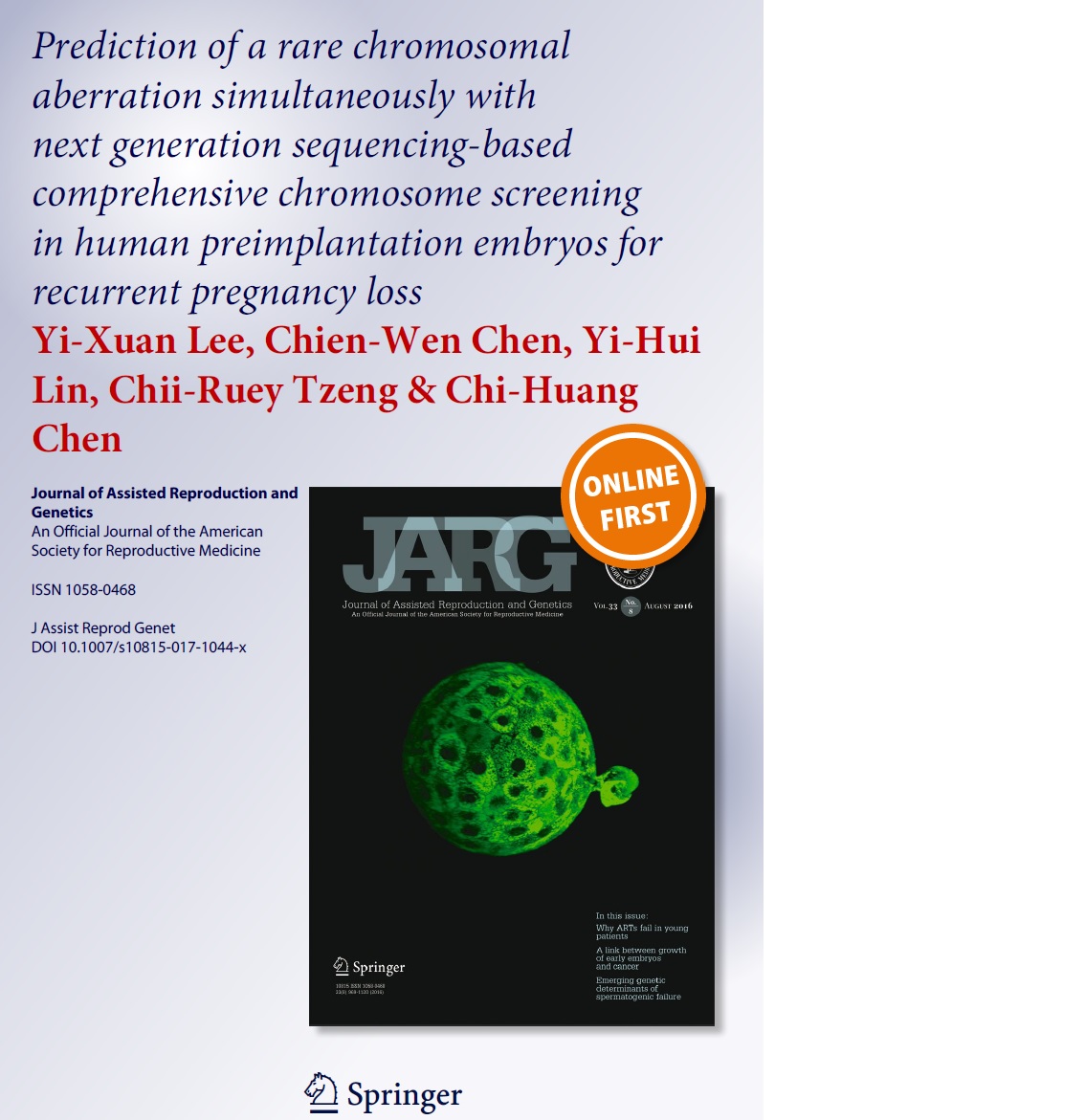
  • 胚胎著床前基因篩檢(PGS)的進階版(NGS)診斷出極小的染色體平衡轉位,經植入正常胚胎一顆健康足月活產,解決了五次習慣性流產。

    本篇發表在國外影響因子2.163的期刊J Assist Reprod Genet. 2017 Sep 30.
    陳醫師身為該患者的主治醫師擔責任作者,指導李怡萱醫師投稿刊登。李怡萱醫師在本篇論文的激勵下發奮考取台北醫學大學臨床醫學研究所博士班預攻讀基因醫學

    中文題目
    同時預測罕見的染色體畸變與次世代(NGS)基於序列的綜合人類植入前胚胎(PGS)中的染色體篩選於習慣性流產

    中文摘要
    摘要採用植入前基因檢測方法,近年來廣泛作為輔助生殖技術的一部分。由於脫氧核糖核酸的突破性發展酸(DNA)測序。隨著進步的技術,並提高下一代的分辨率測序(NGS),廣泛的全面染色體篩查以及小的臨床重大缺失並且可以同時執行重複。在這裡,我們提出罕見染色體畸變的病例:46,XY,dup(15)(q11.2q13),t(16; 18)(q23; p11.2),其中導致正常發育的成人但異常配子
    導致復發性懷孕(RPL)。據我們所知,這是t(16; 18)易位的第一次報告。由NGS平台檢測到的小交換段MiSeq系統同時24染色體非整倍體

    原文版

    Title
    Prediction of a rare chromosomal aberration simultaneously with next generation sequencing-based comprehensive chromosome screening in human preimplantation embryos for recurrent pregnancy loss
    Author
    Lee YX1, Chen CW1,2, Lin YH3,4, Tzeng CR1,5, CHEN CH 6,7
    Abstract Preimplantation genetic testing has been used widely in recent years as a part of assisted reproductive technology (ART) owing to the breakthrough development of deoxyribonucleic acid (DNA) sequencing. With the advancement of technology and increased resolution of next generation sequencing (NGS), extensive comprehensive chromosome
    screening along with small clinically significant deletions and duplications can possibly be performed simultaneously. Here, we present a case of rare chromosomal aberrations: 46,XY,dup(15)(q11.2q13),t(16;18)(q23;p11.2), which resulted in a normally developed adult but abnormal gametes leading to recurrent pregnancy loss (RPL). To our best knowledge, this is the first report of t(16;18) translocation with such a small exchanged segment detected by NGS platform of MiSeq system in simultaneous 24-chromosome aneuploidy screening.

    NGS publised 2017


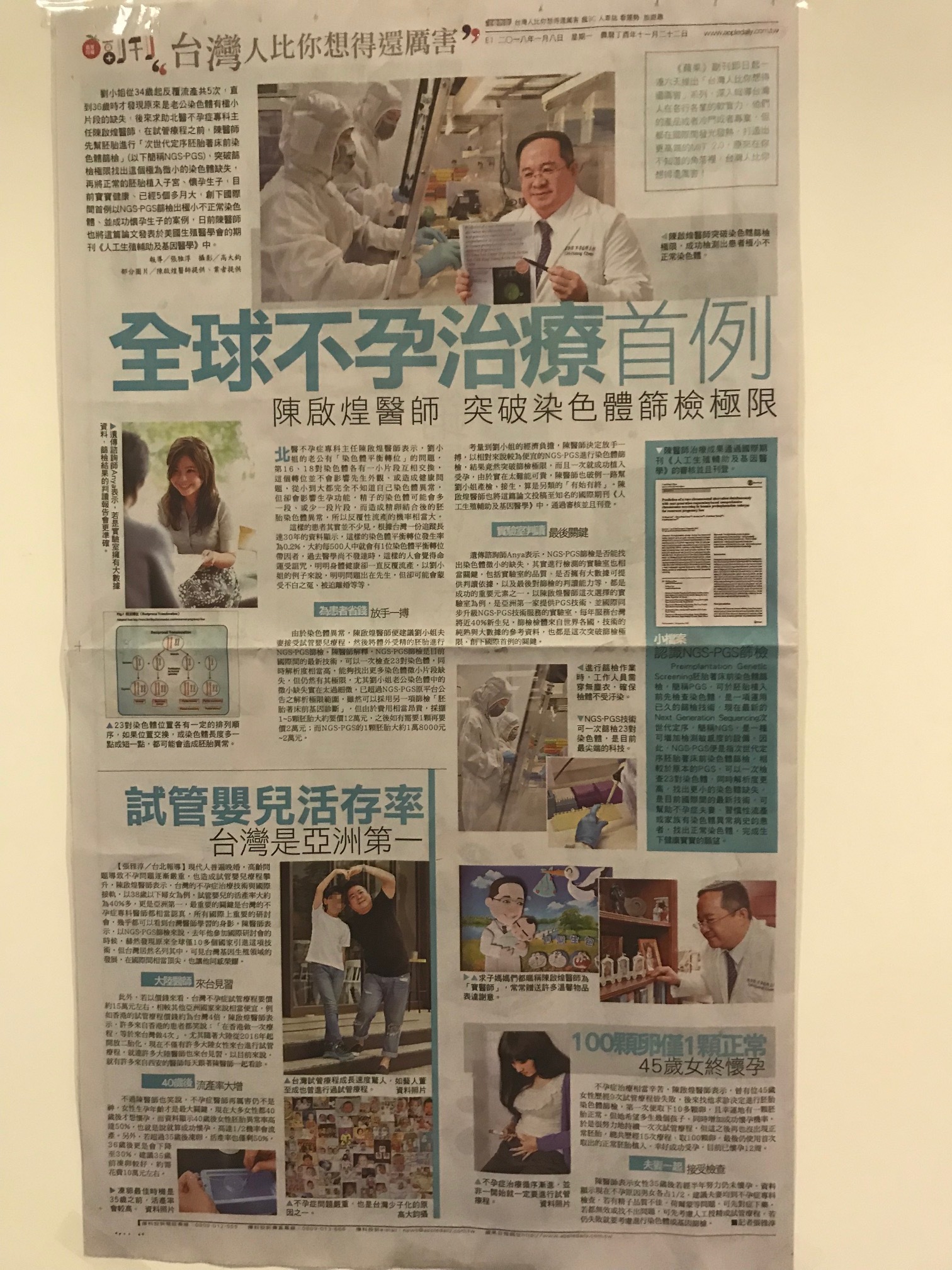
  • 台灣人比你想的還厲害

    台灣人比你想的還厲害
    蘋果》副刊即日(2018.01.08)起一連六天推出「台灣人比你想得還厲害」系列,深入報導台灣人在各行各業的軟實力,他們的產品或者冷門或者專業,但都在國際間發光發熱,打造出更高端的MIT 2.0,原來在你不知道的角落裡,台灣人比你想得還厲害!
    想不到陳醫師是第一棒.

    https://tw.lifestyle.appledaily.com/daily/20180108/37896510/

    https://tw.lifestyle.appledaily.com/daily/20180108/37896524/

    https://tw.lifestyle.appledaily.com/daily/20180108/37896530/


    IMG 2194 2

  • AMH及基礎濾泡最具臨床價值

    最權威的不孕症期刊(第一名)


    Hum Reprod Update. 2011 Jan-Feb;17(1):46-54. Epub 2010 Jul 28.


    Title (題目)


    AMH and AFC as predictors of excessive response in controlled ovarian hyperstimulation: a meta-analysis.


    CONCLUSIONS:


    Both AMH and AFC are accurate predictors of excessive response to ovarian hyperstimulation. Moreover, both tests appear to have clinical value. This opens ways to explore the potential of individualized FSH dose regimens based on ovarian reserve testing


    翻譯為:


    AMH及月經期間基礎濾泡數量(AFC)為預測卵巢刺激是否產生過度刺激的最準確的指標,也最具臨床價值,基於此二指標可作為卵巢庫存的檢驗以決定引卵刺激排卵藥的用量。

  • 懷孕期間吸煙和新生兒出生缺陷的影響

    人類生殖最新報導(生殖期刊第一名) 2011年07月11日 搶鮮版


    孕婦在懷孕期間吸煙和新生兒出生缺陷的影響:一項基於以系統性回顧的基礎上研究173687畸形的病例和1170萬控制組(無畸形的病例)


    英國倫敦大學的研究


    摘要
    背景存在著不確定性,究竟孕婦吸煙與出生缺陷。我們進行的第一次全面系統的審查,以確定哪些具體的畸形都與吸煙。公佈 1959至2010年的觀測研究方法進行鑑定(MEDLINE),包括如果他們報導的比值比(OR)為具有非染色體出生缺陷,婦女在懷孕期間吸煙誰比非吸煙者。潛在的混雜因素調整 OR值分別提取(如產婦年齡和酒精),否則使用未經調整的估計數。172篇文獻使用了綜合分析:共173687例畸形11 674332例未畸形的控制組比較。結果母親吸煙與畸形顯著正相關,被發現包含:心血管/心臟缺損 [OR 1.09,95%可信區間(CI)1.02-1.17];肌肉骨骼缺陷(OR 1.16,95%CI 1.05-1.27);肢體減少缺陷(或1.26,95%CI 1.15-1.39),馬蹄內翻足(OR 1.28,95%CI 1.10-1.47),顱缺陷(OR 1.33,95%CI 1.03-1.73 );面部缺陷(OR 1.19,95%CI 1.06-1.35);眼睛缺陷(OR 1.25,95%CI 1.11-1.40);口面裂(OR 1.28,95%CI 1.20-1.36),胃腸道缺陷(OR 1.27, 95%CI 1.18-1.36);腹裂(OR 1.50,95%CI 1.28-1.76),肛門閉鎖(OR 1.20,95%CI 1.06-1.36);疝氣(OR 1.40,95%CI 1.23-1.59)及隱睾症(OR 1.13,95%CI 1.02-1.25)。反而吸煙者產下尿道下裂(OR 0.90,95%CI 0.85-0.95)和皮膚缺損(OR 0.82,0.75-0.89)的風險降低。對於所有缺陷相結合的OR為 1.01(0.96-1.07),由於其中的缺陷與降低
    風險和無關聯者(包括染色體缺陷)。結論出生缺陷是正與母親吸煙相關,現在應該包括在公眾健康教育議題,以鼓勵更多的婦女在懷孕期間或之前戒煙。


    PS: 要懷孕,戒煙吧!


    原文


    Hum Reprod Update. 2011 Jul 11. [Epub ahead of print]


    Maternal smoking in pregnancy and birth defects: a systematic review based on 173 687 malformed cases and 11.7 million controls.


    Hackshaw A, Rodeck C, Boniface S.

    SourceCRUK & UCL Trials Centre, University College London , 5th Floor, 90 Tottenham Court Road, London W1T 4TJ , UK .


    Abstract

    BACKGROUND There is uncertainty over whether maternal smoking is associated with birth defects. We conducted the first ever comprehensive systematic review to establish which specific malformations are associated with smoking. METHODS Observational studies published 1959-2010 were identified (Medline), and included if they reported the odds ratio (OR) for having a non-chromosomal birth defect among women who smoked during pregnancy compared with non-smokers. ORs adjusted for potential confounders were extracted (e.g. maternal age and alcohol), otherwise unadjusted estimates were used. One hundred and seventy-two articles were used in the meta-analyses: a total of 173 687 malformed cases and 11 674 332 unaffected controls. RESULTS Significant positive associations with maternal smoking were found for: cardiovascular/heart defects [OR 1.09, 95% confidence interval (CI) 1.02-1.17]; musculoskeletal defects (OR 1.16, 95% CI 1.05-1.27); limb reduction defects (OR 1.26, 95% CI 1.15-1.39); missing/extra digits (OR 1.18, 95% CI 0.99-1.41); clubfoot (OR 1.28, 95% CI 1.10-1.47); craniosynostosis (OR 1.33, 95% CI 1.03-1.73); facial defects (OR 1.19, 95% CI 1.06-1.35); eye defects (OR 1.25, 95% CI 1.11-1.40); orofacial clefts (OR 1.28, 95% CI 1.20-1.36); gastrointestinal defects (OR 1.27, 95% CI 1.18-1.36); gastroschisis (OR 1.50, 95% CI 1.28-1.76); anal atresia (OR 1.20, 95% CI 1.06-1.36); hernia (OR 1.40, 95% CI 1.23-1.59); and undescended testes (OR 1.13, 95% CI 1.02-1.25). There was a reduced risk for hypospadias (OR 0.90, 95% CI 0.85-0.95) and skin defects (OR 0.82, 0.75-0.89). For all defects combined the OR was 1.01 (0.96-1.07), due to including defects with a reduced risk and those with no association (including chromosomal defects). CONCLUSIONS Birth defects that are positively associated with maternal smoking should now be included in public health educational materials to encourage more women to quit before or during pregnancy.


  • 在卵巢刺激下對甲狀腺功能的影響

    生育與絕育 2011年7月8日。搶鮮版

    在卵巢刺激下對甲狀腺功能的影響:系統回顧


    來自希臘的研究

    摘要
    目的:研究有關在婦女卵巢刺激(OS)對甲狀腺功能和甲狀腺自體免疫(TAI)的變化。

    設計:研究資格的系統評估報告在婦女卵巢刺激(OS)之前和期間 OS或OS後 1個月內甲狀腺功能或甲狀腺自體免疫(TAI)的數據

    背景:學術醫院。

    病人(S):婦女甲狀腺功能異常或甲狀腺自體免疫(TAI)(N=419)和對照組(n=425)。

    干預(S):卵巢刺激。

    主要觀察指標(S):血清TSH,游離甲狀腺素,游離三碘和甲狀腺抗體。

    結果:7項研究,2000年至2011年,被列入。血清TSH濃度明顯增加於三項研究的報導,另兩項研究並沒有改變。兩項研究顯示血清游離甲狀腺素濃度增加了,一項研究沒有改變之一,並在另一個下降。只有一研究中進行了測量血清游離三碘,濃度沒有改變。在一項研究中,濃度降低,另兩項研究,即使是在存在甲狀腺功能的變化,甲狀腺抗體並沒有改變。

    結論(S):現有的證據是不確定婦女卵巢刺激(OS)對甲狀腺功能影響大。血清TSH濃度可能在卵巢刺激(OS)1個月內期間或之後增加,超過建議為懷孕的頭三個月閾值的2.5mU/ L,但進一步的前瞻性研究來提供確鑿的證據支持或反對的普遍評估甲狀腺功能受卵巢刺激(OS)影響仍有必要的。


    PS:有很多婦女有甲狀腺疾病,不孕婦女有甲狀腺疾病者常期擔心人工生殖會影響甲狀腺功能和甲狀腺自體免疫(TAI)的變化而大量使用藥物治療。大型研究顯示未定論,見仁見智。


    Fertil Steril. 2011 Jul 8. [Epub ahead of print]

    Thyroid function during ovarian stimulation: a systematic review.

    Mintziori G, Goulis DG, Toulis KA, Venetis CA, Kolibianakis EM, Tarlatzis BC.

    Source

    Unit of Reproductive Endocrinology, First Department of Obstetrics and Gynecology, Medical School, Aristotle University of Thessaloniki, Thessaloniki, Greece.

    Abstract

    OBJECTIVE:

    To review the evidence regarding thyroid function and thyroid autoimmunity (TAI) changes in women undergoing ovarian stimulation (OS).

    DESIGN:

    Studies eligible for the systematic review were those that reported data on thyroid function or TAI both before and during OS or within 1 month after OS.

    SETTING:

    Academic hospital.

    PATIENT(S):

    Women with abnormal thyroid function or TAI (n = 419) and controls (n = 425).

    INTERVENTION(S):

    Ovarian stimulation.

    MAIN OUTCOME MEASURE(S):

    Serum TSH, free thyroxine, free tri-iodothyronine and thyroid antibodies.

    RESULT(S):

    Seven studies, between 2000 and 2011, were included. Serum TSH concentrations were significantly increased in three studies and were not changed in two studies. Serum free thyroxine concentrations were increased in two studies, were not changed in one, and were decreased in another. Serum free tri-iodothyronine concentrations were not changed in the only study in which they were measured. Thyroid antibody concentrations were decreased in one study and were not changed in two studies, even in the presence of changes in thyroid function.

    CONCLUSION(S):

    The current evidence is inconclusive regarding OS effect on thyroid function or TAI. Serum TSH concentrations may be increased during or within 1 month after OS, exceeding the threshold of 2.5 mU/L suggested for the first trimester of pregnancy, but further prospective studies are needed to provide conclusive evidence for or against universal evaluation of thyroid function and TAI in women undergoing OS.

  • 比較GnRH拮抗劑與 GnRH促進劑用於卵巢反應不佳者接受試管治療的結果

    人類生殖 (生殖期刊第二名)。 2011年7月21日。 搶鮮版

    比較GnRH拮抗劑與 GnRH促進劑用於卵巢反應不佳者接受試管治療的結果


    中華人民共和國的研究

    摘要 

    背景


    比較GnRH拮抗劑與 GnRH促進劑用於卵巢反應不佳者接受試管治療的結果


    方法


    我們檢索所有發表的文章編入MEDLINE(2050至10年),EMBASE(1974年至2010年)和中國國家知識基礎設施(CNKI,1994-2010)。數據分析由兩名獨立評審任何隨機對照研究,比較GnRH拮抗劑與 GnRH促進劑用於卵巢反應不佳者接受試管治療IVF / ICSI被包括在內。這次搜索64篇相關論文,從其中14篇相關論文符合標準。進行這項綜整分析,涉及566例試管嬰兒在GnRH拮抗劑組和561例患者為促性腺激素釋放激素(GnRH)促進劑組,審查管理器4.2軟件。比值比(OR)和加權均數差(WMD)及其95%可信區間(CI)被用來評估二分和連續的數據,分別為。結果十四個符合條件的研究,包括在本綜整分析分析。GnRH拮抗劑比GnRH促進劑了統計上顯著的較短的刺激排卵時間,(P = 0.04; WMD:-1.88,95%CI:-3.64,-0.12),但在數卵母細胞中檢索(P = 0.51; WMD:-0.17,95%CI -0.69,0.34)或成熟的卵母細胞的數量檢索(P = 0.99; WMD:-0.01,95%CI:-1.14,1.12)無顯著差異,。此外發現兩者在週期取消率(CCR,P = 0.67,OR:1.01,95%CI:0.71-1.42)或臨床妊娠率(CPR,P = 0.16,OR:1.23,95%CI: 0.92,1.66),無顯著差異,。結論是GnRH拮抗劑的使用對卵巢反應不佳接受試管受精明顯的優勢是顯著的較短的刺激排卵時間。然而GnRH拮抗劑與GnRH促進劑之間取卵數,成熟卵數,週期取消率及臨床懷孕率沒有統計學差異。這些結果可能有助於我們的臨床操作。然而,進一步控制隨機前瞻性研究具有較大的樣本量是必要的。 

    PS: 僅管這篇的結論顯示GnRH拮抗劑與GnRH促進劑之間取卵數,成熟卵數,週期取消率及臨床懷孕率沒有統計學差異。多數的研究,研討會或經驗法則仍傾向卵巢反應不佳者接受試管治療不favor GnRH促進劑為主的長療程,怕卵巢壓抑過度導至用藥過重,引卵時間過長 。

    Hum Reprod. 2011 Jul 21. [Epub ahead of print]

    Comparisons of GnRH antagonist versus GnRH agonist protocol in poor ovarian responders undergoing IVF.

    Pu D, Wu J, Liu J.

    Source

    Department of Obstetrics and Gynecology, The First Affiliated Hospital of Nanjing Medical University, 210029 Nanjing, People’s Republic of China.

    Abstract

    BACKGROUND In view of the discrepancies about the GnRH antagonist (GnRH-ant) ovarian stimulation protocols having some potential advantages compared with the GnRH agonist (GnRH-a) protocols in poor ovarian responders IVF/ICSI, a meta-analysis of the published data was performed to compare the efficacy of GnRH-ant versus GnRH-a protocols for ovarian stimulation in IVF poor response patients. METHODS We searched for all published articles indexed in MEDLINE (1950-2010), EMBASE (1974-2010) and China National Knowledge Infrastructure (CNKI, 1994-2010). Any randomized controlled study that compared the GnRH-ant with GnRH-a in ovarian stimulation protocols for poor responders undergoing IVF/ICSI was included, and data were extracted independently by two reviewers. The searches yielded 64 articles, from which 14 studies met the inclusion criteria. We performed this meta-analysis involving 566 IVF patients in a GnRH-ant protocol group and 561 patients in a GnRH-a protocol group with Review Manager 4.2 software. Odds ratio (OR) and weighted mean difference (WMD) with 95% confidence intervals (CIs) were used to evaluate dichotomous and continuous data, respectively. RESULTS Fourteen eligible studies were included in this meta-analysis. GnRH-ant protocols resulted in a statistically significantly lower duration of stimulation compared with GnRH-a protocols (P = 0.04; WMD: -1.88, 95% CI: -3.64, -0.12), but there was no significant difference in the number of oocytes retrieved (P = 0.51; WMD: -0.17, 95% CI -0.69, 0.34) or the number of mature oocytes retrieved (P = 0.99; WMD: -0.01, 95% CI: -1.14, 1.12). Moreover, no significant difference was found in the cycle cancellation rate (CCR, P = 0.67; OR: 1.01, 95% CI: 0.71-1.42) or clinical pregnancy rate (CPR, P = 0.16; OR: 1.23, 95% CI: 0.92, 1.66). CONCLUSIONS Clear advantage was gained in duration of stimulation with GnRH-ant in poor ovarian responders undergoing IVF, although there was no statistical difference in the number of oocytes retrieved, the number of mature oocytes retrieved, the CCR and CPR between GnRH-ant and GnRH-a protocols. These results may be helpful to our clinical practice. However, further controlled randomized prospective studies with larger sample sizes are needed.